Employee retention in Malta: Factors you can’t ignore


Last updated
October 14, 2026
Share on


Employee retention in Malta is more challenging than in larger markets. The talent pool is limited, word-of-mouth spreads quickly, and finding replacements for skilled professionals takes time and money, which many organisations overlook.
Five main factors influence employees’ decisions to stay or leave: fair pay, career growth, manager quality, flexibility, and culture. While salary is crucial, 51% of Malta’s workforce also values flexibility, and 46% point to career advancement as a reason for job changes.
This guide covers all five factors, helps you identify your retention gaps, and links to specific guides for each area.
Why retention is harder in Malta than in larger markets
In a large economy, a disengaged employee is a productivity problem. In Malta, it’s more like a crisis.
The talent pool is small, and replacing a skilled professional rarely takes just four weeks. When a senior finance or technology hire leaves, the search can take months. During this time, the remaining team must handle the extra workload, raising the risk of another departure.
The word-of-mouth effect makes things worse. When a company earns a reputation for high staff turnover, the news spreads quickly. Potential candidates often rule out these employers before applying, making it slower and more expensive to find the next hire.
There’s also the issue of the international workforce. More than one third of Malta’s workforce is foreign-born. At Konnekt, we see that relocated workers are more likely to leave within the first year than local hires. Many arrive with unrealistic expectations about life in Malta, cultural adjustments are underestimated, and they struggle to connect with the organisation.
The true cost of losing an employee
Many organisations underestimate the full cost of staff turnover, often focusing only on recruitment fees.
- Direct costs: recruitment, advertising, onboarding, and training.
- Indirect costs: reduced productivity, lower morale, and the loss of institutional knowledge. When the workload increases for other employees in the team, this can have a ripple effect if a replacement is not found immediately, leading to more people from the same team leaving.
The greatest impact often lies in what’s hardest to measure – the experience, client relationships, and practical know-how that leave with departing employees.
In small markets like Malta, reputation carries real weight. Word spreads quickly, and once a business becomes known as a place where people rarely stay long, attracting and keeping talent becomes slower and more costly.
| Cost type | Examples | Typical visibility |
| Recruitment & advertising | Agency fees, job board spend, management time | High – appears on invoices |
| Onboarding & training | Time to productivity, trainer hours, materials | Medium – tracked inconsistently |
| Lost productivity | Output gap during vacancy and ramp-up period | Low – rarely calculated |
| Knowledge loss | Client relationships, process know-how, institutional memory | Very low – invisible until it escalates |
| Team morale & secondary attrition | Engagement drop in remaining staff | Very low – often attributed elsewhere |
The biggest impact often comes from what’s hard to measure. This includes client relationships, institutional knowledge, and practical skills that go when an employee leaves.
The five retention factors Malta employers can’t ignore
Employee loyalty replies on an employer value proposition that goes beyond salary. The KonnektTalexio Candidate Survey 2025, which included 500 Maltese workers, reveals what drives job changes and keeps people in their roles.
1. Fair pay
Pay remains fundamental, but it’s not the only driver of job changes. According to the KonnektTalexio Candidate Survey 2025 conducted by Esprimi, salary and benefits ranked as the top motivator for 65% of respondents when considering a job change in Malta.
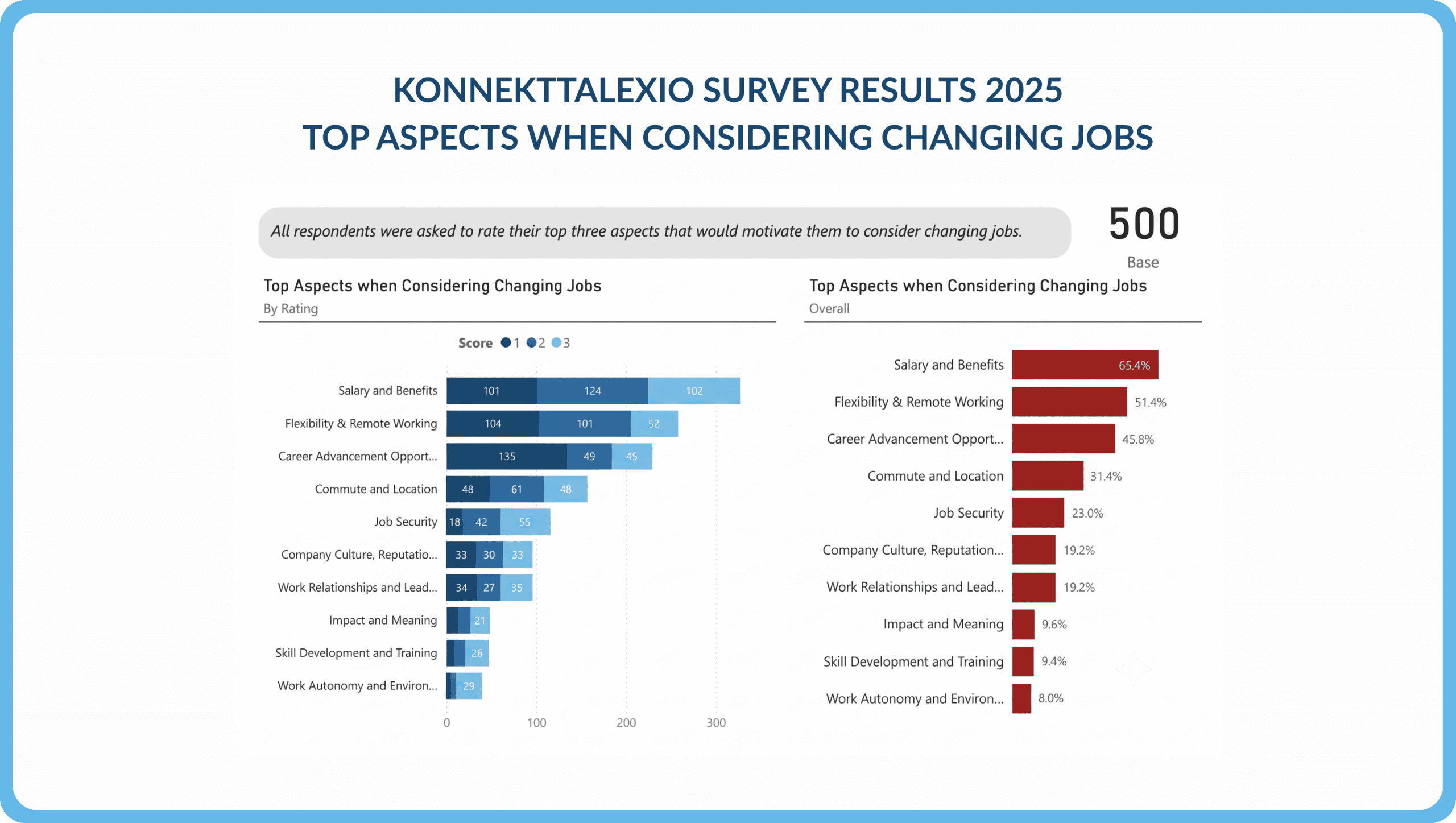
However, flexibility (51%) and career advancement opportunities (46%) closely followed, showing that financial rewards alone don’t secure loyalty. The same survey found that location flexibility and company reputation also heavily influence application decisions, highlighting that employees in Malta value balance, growth, and trust just as much as pay.
2. Career growth and development
Career progression is one of the strongest motivators for job movement in Malta. The KonnektTalexio Candidate Survey 2025 by Esprimi found that 46% of respondents listed career advancement among the top three reasons for considering a job change, just behind salary and flexibility. When employees can’t see a path to grow, they begin to look elsewhere.
That shows that internal mobility becomes a strategic advantage. Investing in clear career paths, mentoring, and training helps retain skilled employees and reduces reliance on a limited external talent pool. Growth opportunities don’t just fill skill gaps but they give people a tangible reason to build their future within the organisation.
3. Recognition and manager quality
According to the Gallup State of the Global Workplace 2026 Report, managers are responsible for up to 70% of team engagement variance, and disengaged leaders rarely manage to retain engaged teams.
Recognition plays a major role: employees who genuinely feel appreciated are less likely to leave.
Regular, meaningful recognition, especially peer-to-peer, builds both motivation and connection. However, the biggest opportunity lies in developing managers, as coaching and leadership training deliver the strongest return on retention.
The most revealing pattern we see in exit conversations is what employees do not say. The stated reason for leaving is usually salary or a better opportunity. The real reason, more often than not, is a manager. Someone whose feedback was ignored. A team where recognition never happened. A leader who was technically competent but disengaged from the people around them.
The biggest return on retention investment, in our experience at Konnekt, comes not from perks but from developing managers – through coaching, leadership training, and creating environments where feedback flows both ways.
4. Flexibility and work-life balance
Flexibility is now a core expectation. The KonnektTalexio Candidate Survey 2025 found that flexibility and remote working ranked as the second most important factor (51%) when considering a job change, just after salary and benefits. It was also among the top perks of choice, with 74% of respondents preferring flexible working hours and 62% valuing remote work options in their ideal job offer.
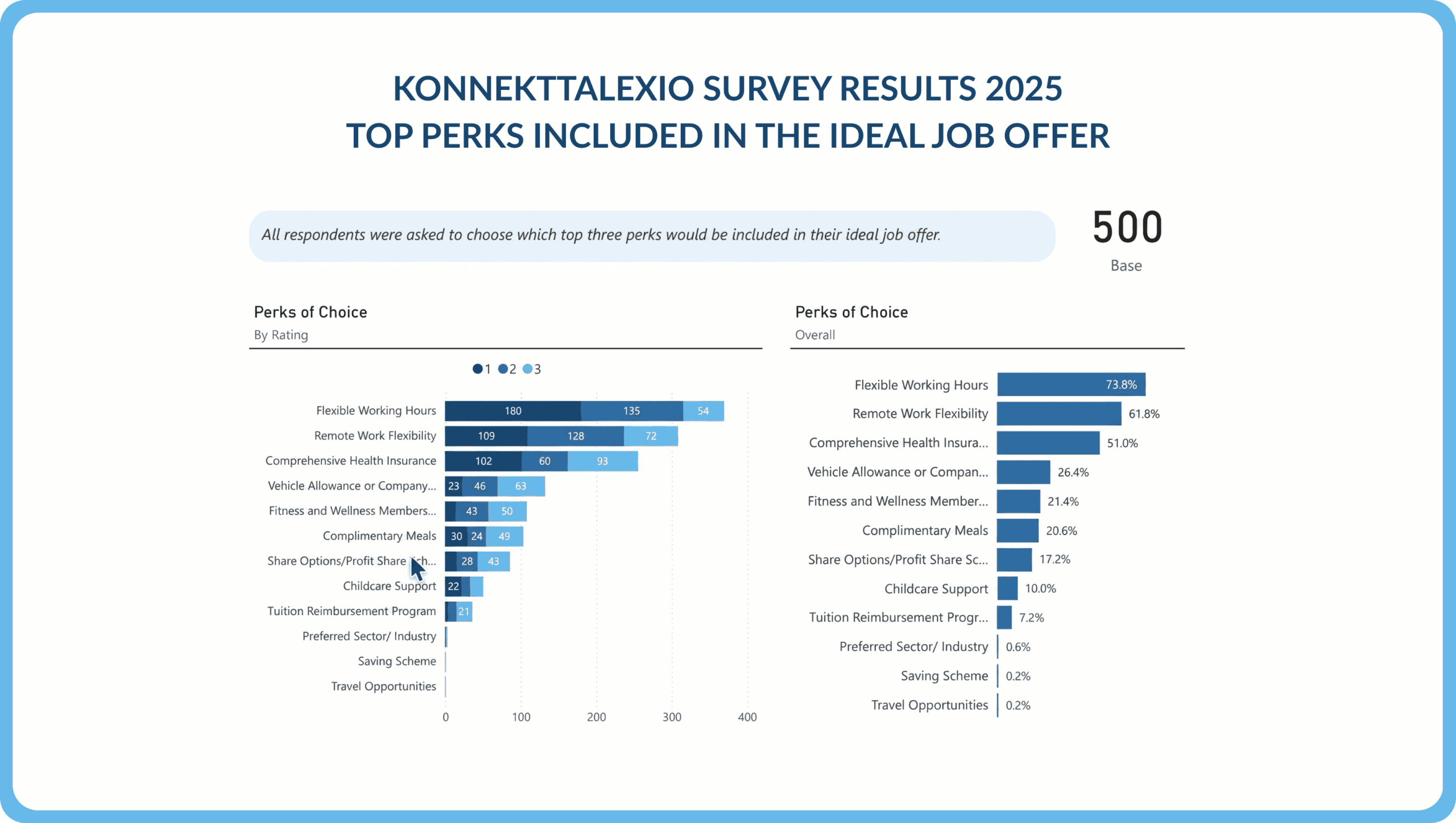
These findings show that flexibility directly shapes how attractive an employer appears in Malta’s market. Companies that design roles around clear communication norms, purposeful collaboration, and supportive management can meet this demand without losing productivity.
From experience working closely with candidates, flexibility has become so important that many are willing to move even for a slightly lower salary if the role offers better balance and trust.
5. Culture, belonging, and purpose
Company culture is one of the strongest factors influencing job choices in Malta. Our study found that company culture, reputation, and leadership quality were key considerations for 19% of respondents when deciding to change jobs, while team dynamics and relationships were the main reasons people preferred working for local companies.
In Malta’s multicultural market, where foreign professionals make up around 40% of the workforce, belonging and appreciation are vital for retention. Creating a workplace where people feel included, supported, and connected reduces turnover and strengthens long-term commitment.
Purpose adds an additional layer. When employees understand how their work contributes to a meaningful goal, motivation and engagement rise, turning culture from an abstract concept into a tangible business advantage.
At Konnekt we see that what pushes people away, regardless of pay, is the feeling that they are not being heard. When employees feel ignored, especially when their feedback is meant to help the organisation improve, disengagement accelerates.
How to identify your retention gaps
You can’t fix what you can’t measure. Start by running a retention audit that combines both data and employee feedback.
Step 1 — Quantitative data (what is happening):
- Overall turnover rate (voluntary exits ÷ average headcount × 100)
- Voluntary versus involuntary exits
- First-year attrition rate
- Regrettable turnover (high performers who chose to leave)
Step 2 — Qualitative data (why it is happening):
- Pulse and engagement surveys such as Talexio Team Voice provide structured, confidential feedback at scale
- Stay interviews with key employees – structured conversations with people who are staying, to understand what would make them leave
- Exit interview analysis – identifying recurring themes, with the caveat that departing employees rarely share the real reason on the way out.
A useful self-assessment:
| Metric | Do you track this? | Is it improving? |
| Overall voluntary turnover rate | ☐ Yes / ☐ No | ☐ Yes / ☐ No / ☐ Unknown |
| First-year attrition | ☐ Yes / ☐ No | ☐ Yes / ☐ No / ☐ Unknown |
| Regrettable turnover (high performers) | ☐ Yes / ☐ No | ☐ Yes / ☐ No / ☐ Unknown |
| Employee engagement / pulse survey | ☐ Yes / ☐ No | ☐ Yes / ☐ No / ☐ Unknown |
| Exit interview themes documented | ☐ Yes / ☐ No | ☐ Yes / ☐ No / ☐ Unknown |
Patterns such as high turnover under a particular manager or consistently low “belonging” scores are clear warning signs. This kind of diagnostic approach turns HR data into a predictive tool, allowing you to act before resignations begin.
Retention starts before the contract is signed
Understanding why people stay is only half the challenge – hiring people who are likely to stay is the other half.
Retention-focused hiring begins long before a contract is signed. In our work at Konnekt, we see the difference it makes when the recruitment process stays aligned from the very start. Clear expectations about work environment, flexibility, career paths, and salary drastically reduce the risk of early turnover.
At Konnekt, we regularly communicate with both the employer and the candidate to ensure long term success for both.
- Hiring for growth: We identify candidates whose career goals align with your organisation’s development opportunities.
- Hiring for culture: Our approach looks beyond technical skills to assess purpose and cultural fit.
- Setting realistic expectations: We make sure every candidate understands the role and working environment clearly, reducing the risk of early turnover.
What also differentiates our approach is what happens after a candidate joins. The first months are critical, and staying connected with both sides during that period helps prevent misunderstandings, encourages integration, and strengthens long-term commitment.
The most powerful retention strategy remains simple: listen to your people. Staying close to market data, understanding shifting employee expectations, and adapting quickly to new ways of working give companies a real competitive edge, especially in a market as tight as ours.
Frequently asked questions
The stated reasons in exit interviews are usually salary, career growth, or a better opportunity elsewhere. The actual drivers, observed consistently across Konnekt’s placement data, are more often manager quality, feeling that feedback is ignored, and a lack of visible career progression. Pay is important, but it is rarely the whole story.
Direct replacement costs such as recruitment, onboarding, and time to full productivity, are typically estimated at between 50% and 200% of annual salary, depending on seniority and specialism. In Malta, indirect costs (morale impact, institutional knowledge loss, secondary attrition risk) frequently exceed the direct costs, particularly in small or specialist teams.
Yes, materially. The KonnektTalexio Candidate Survey 2025 found that 74% of Malta’s workforce prefer flexible working hours, and 62% value remote work flexibility in their ideal job offer. Candidates at Konnekt regularly cite genuine flexibility as a reason they accepted a role over a higher-paying alternative.
The highest-impact non-salary retention levers are career visibility (do employees know where they can go within the organisation?), manager quality (is someone actively investing in their development?), and psychological safety (do they feel heard?). Flexible working costs nothing structurally. Recognition programmes can be low-cost and high-impact.
A stay interview is a structured conversation with a current employee, specifically asking what keeps them in the role and what would make them consider leaving. Unlike exit interviews, which capture reasons after the damage is done, stay interviews give employers the opportunity to act on concerns while the person is still there.
Start with your voluntary turnover rate, first-year attrition, and regrettable turnover figures. Then add qualitative data through engagement surveys and stay interviews. Look for patterns – high turnover under specific managers, consistent themes in exit feedback, elevated attrition among relocated workers. Also, contact employee engagement surveys, such as Team Voice, to get more insights into employee engagement and motivation.

About the author: Nicole Hili Timbol is a Candidate Engagement Lead, specialising in sourcing and placing blue-collar professionals across various industries. Committed to building strong client relationships and connecting skilled candidates with the right career opportunities.