Employee retention in Cyprus: What employers cannot ignore


Share on


Cyprus employers are finding it harder to retain employees. Unemployment is near record-low levels and job vacancies remain high, giving employees more opportunities to change jobs. This is reflected in KonnektTalexio’s “Trends in the Cypriot Labour Market” report, based on a nationally representative CYMAR survey of Cypriot workers, which found that 67.1% of respondents are open to changing jobs, whether actively looking or considering a move.
With fewer available candidates and many employees open to new opportunities, retention is critical for employers in Cyprus, and it cannot rely on salary alone. Flexible working, clear career progression, good management and a strong employee experience all play an important role in giving people reasons to stay.
Why retention has become harder in Cyprus
Cyprus is a candidate-driven labour market. Unemployment remains near record-low levels, while the vacancy rate reflects continued competition for talent. For employers, this means experienced employees can be difficult to replace and have more opportunities to move.
KonnektTalexio’s research shows just how open employees are to those opportunities. In a nationally representative CYMAR survey of 500 respondents in Cyprus, 67.1% said they were open to changing jobs, whether actively searching, passively considering opportunities or planning to look soon.
This does not mean most employees are preparing to leave. But it does mean your retention risk extends beyond those who are visibly unhappy. Employees who are satisfied today may still consider a better opportunity tomorrow, making it increasingly important to give good people clear reasons to stay.
Why employees leave: salary is only part of the answer
KonnektTalexio’s labour market research found that salary and benefits were the most important factors when considering a job change, followed by career advancement and job security.
Our recruiters at Konnekt see a similar pattern in conversations with candidates. Competitive pay is important, particularly when employees feel their salary has fallen behind the market. But unclear career progression, lack of recognition and limited flexibility can be just as important in prompting someone to consider leaving.
These concerns often build gradually. An employee may be happy with their salary but unable to see their next career step. Another may value their role but want greater flexibility. Over time, an external opportunity can offer a reason to act on those frustrations.
Managers should therefore watch for changes in engagement, such as reduced enthusiasm, less participation or withdrawal from the team. Retention is not only an HR responsibility. Regular conversations between managers and employees can identify concerns early, before someone has already decided to leave.
Which employees are hardest to retain
Retention is particularly challenging for skills that are in high demand.
Our recruiters see strong competition in Cyprus for technology, FX and fintech talent, particularly Full-Stack Developers, DevOps professionals and Data Specialists in Limassol and Nicosia. Compliance and AML Officers, as well as qualified ACCA Accountants and Auditors, are also difficult to retain.
Professionals in these areas often receive opportunities without actively looking for a new job. In particularly competitive roles, our recruiters see candidates securing 15-20% salary increases when changing employers.
This makes keeping salaries competitive important, but continually competing on pay alone is difficult. Employers need to consider the overall employment proposition:
| What employees consider | What employers should review |
| Salary and benefits | Are pay and benefits competitive and reviewed regularly? |
| Flexibility | Can employees organise work around their lives where the role allows it? |
| Career progression | Can employees clearly see what their next step could be? |
| Recognition | Do employees receive meaningful feedback for good work? |
| Management | Do managers provide clarity, support and appropriate autonomy? |
| Workload | Is the employee’s workload sustainable over time? |
The question is not whether you can offer everything an employee might find elsewhere. It is whether your overall proposition gives them enough reasons to continue building their career with you.
What actually improves employee retention
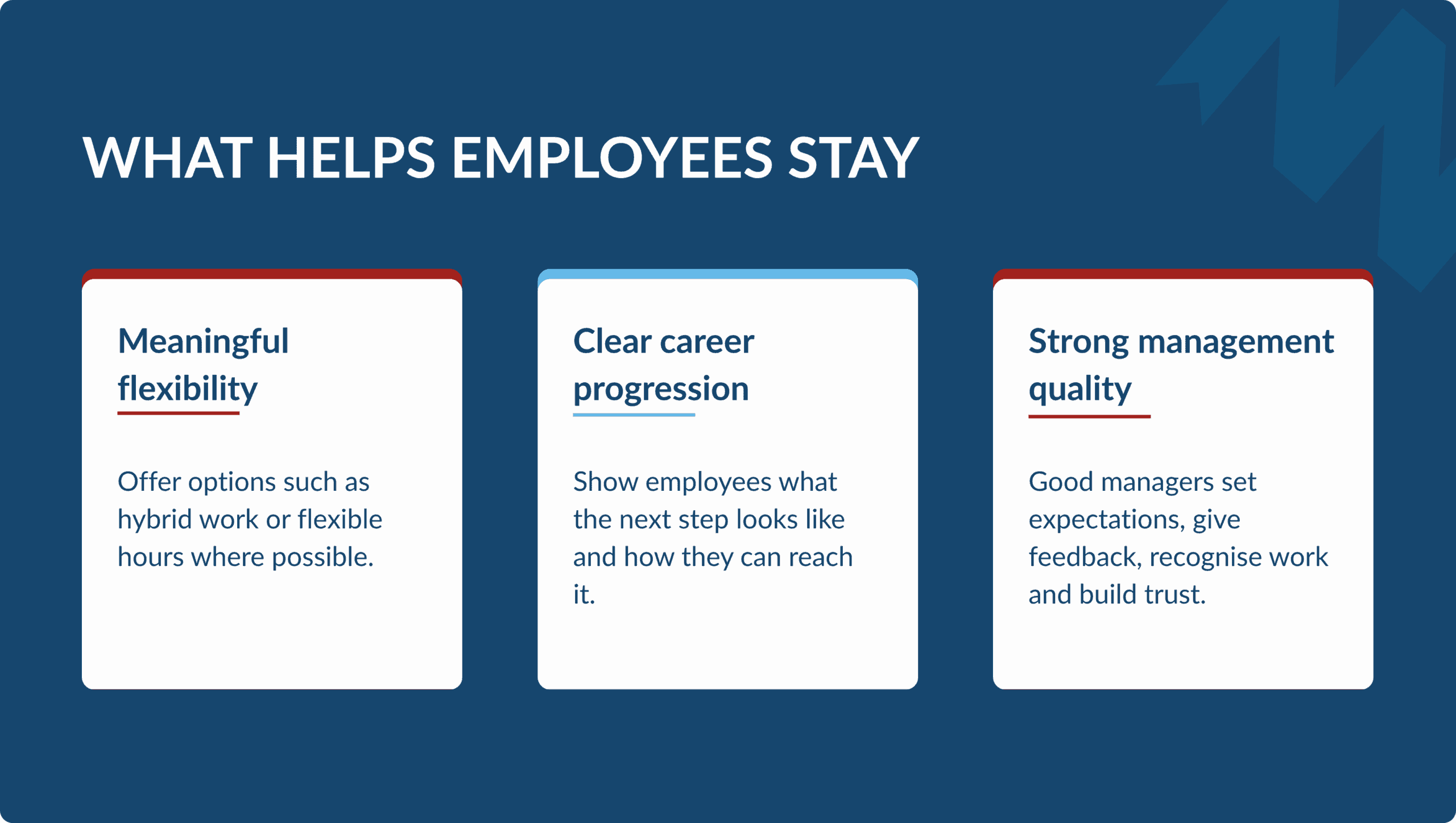
There is no single solution to employee retention. From conversations our recruiters have with candidates in Cyprus, three areas consistently matter: flexibility, career progression and management quality.
Offer meaningful flexibility
Flexibility has become an important part of what employees expect from work. This does not necessarily mean offering fully remote roles. Depending on your business, it could include hybrid working, flexible start and finish times, or agreed core hours.
The key is to be clear about what you offer and apply it consistently. As our recruiters discuss in their broader guidance on hiring and retaining talent in Cyprus, employers increasingly need to consider the overall employment experience when competing for skilled people.
Make career progression clear
Employees are more likely to consider opportunities elsewhere when they cannot see how they can progress within their current organisation.
Give people a clear understanding of what their next step could be, what is required to get there and how you will support their development. This could include defined career levels, transparent promotion criteria, regular development discussions and opportunities to build new skills.
Our recruiters regularly speak with candidates who are not leaving because they dislike their employer. They are leaving because they believe they need to move elsewhere to progress.
Pay attention to management quality
The relationship with a direct manager can have a significant influence on whether someone stays.
Our recruiters hear about micromanagement, lack of recognition and difficult workplace cultures from candidates considering a move. Managers can reduce these frustrations by setting clear expectations, giving useful feedback, recognising good work and giving employees appropriate autonomy.
Regular conversations matter too. They give managers an opportunity to understand what employees need and address concerns before those concerns become reasons to leave.
The first 6-12 months matter
Retention starts long before someone considers resigning. The first year is particularly important because new employees are comparing the reality of the job with what they expected when they joined.
A strong onboarding process should provide clarity from the beginning. Employees need to understand their responsibilities, what is expected of them, who they can turn to for support and how their work contributes to the organisation.
Regular check-ins help you identify problems early. Our recruiters recommend conversations with the direct manager and HR throughout the first months, rather than waiting for a formal probation review.
These conversations do not need to be complicated. Ask whether the role matches expectations, whether the employee has the support they need and whether anything is making their job unnecessarily difficult.
The important thing is to create opportunities for employees to speak before small frustrations become reasons to leave.
What a retention improvement can look like in practice
Improving retention does not always require major changes or expensive new benefits.
The Konnekt team recently advised a professional services business in Cyprus that was losing mid-level employees to larger corporate employers. Employees had limited visibility over career progression, while the company’s traditional management approach offered relatively little flexibility.
The business began moving towards a clearer, tiered progression model, giving employees a better understanding of the career levels available and what they needed to demonstrate to progress. It also introduced flexible core hours to give employees greater autonomy over their working day. The changes are gradual, but the team has already become more stable.
If you are experiencing retention challenges or want to understand what candidates in Cyprus expect from employers, speak to our Konnekt Cyprus recruiters. We can share what we are seeing in the market and help you identify where your retention approach could be strengthened.
Frequently asked questions
Cyprus has very low unemployment and a high level of demand for workers. This makes replacing experienced employees more difficult. At the same time, KonnektTalexio’s research found that 67.1% of surveyed respondents were open to changing jobs, making retention an important part of workforce planning.
Salary remains important. KonnektTalexio’s research ranked salary and benefits as the strongest consideration when respondents thought about changing jobs. However, career advancement also ranked highly, while our recruiters regularly see flexibility, recognition and management quality influence decisions to leave.
Our recruiters currently see particularly strong competition for technology, FX, fintech, compliance, AML, accounting and audit professionals. Full-Stack Developers, DevOps professionals and Data Specialists in Limassol and Nicosia are among the roles where employees may receive frequent approaches from other employers.
Start with the parts of the employee experience that matter most. Give employees clear progression opportunities, appropriate flexibility, regular feedback and good management.
From the beginning of employment. The first 6-12 months help determine whether an employee feels supported and can see a future with the organisation. Structured onboarding and regular conversations with managers and HR can identify concerns before they develop into reasons to leave.

About the author: With more than 15 years of experience in Human Resources, Christiana has built a successful career, starting at KPMG and later taking on strategic HR roles in organisations such as EY.
Specialising in recruitment, talent acquisition, and cross-border hiring, she focuses on creating solutions that connect talented people with the needs of organisations, helping businesses build strong teams that drive growth.