Pay, compensation & compliance for Malta employers: 2026 Guide


Last updated
October 14, 2026
Share on


This guide is intended as general information and does not constitute legal advice. For advice specific to your organisation, consult a qualified employment lawyer.
The rules around recruitment and pay in Malta have changed. Malta has transposed the EU Pay Transparency Directive through the Equal Pay (Transparency and Reporting) Regulations, 2026, L.N. 173 of 2026, published on 5 June 2026. The Regulations now form a key part of Malta’s legal framework for equal pay and pay transparency before and during employment.
While the legal details are best reviewed with employment lawyers, this article explains how Malta’s new regulations affect recruitment, salary transparency and HR strategy. Employers should now focus on compliance while also using greater pay transparency to strengthen recruitment and employer branding.
What do Malta’s Equal Pay Regulations require?
At their core, the regulations require employers to have pay structures that ensure equal pay between women and men performing equal work or work of equal value. These structures must allow roles to be compared using objective, gender-neutral criteria, including skills, effort, responsibility and working conditions, together with other relevant factors and soft skills where appropriate. Where employee representatives exist, the relevant criteria must be agreed with them.
At a glance, here’s what the Maltese regulations require:
- Applicants must receive information about the initial pay or pay range for the position, based on objective and gender-neutral criteria, before the recruitment process is concluded. Relevant collective agreement provisions must also be provided where applicable.
- Employers, including anyone recruiting on their behalf, may not ask applicants about pay received in their current or previous employment.
- Job titles and vacancy notices must be gender-neutral, and recruitment processes must be conducted in a non-discriminatory manner.
- Employers must establish pay structures that ensure equal pay for equal work or work of equal value.
- Workers have specific rights to written information about their own pay and comparative average pay levels, and pay progression.
- Employers with at least 100 workers will have formal gender pay-gap reporting duties, although the first reporting dates vary by workforce size.
How does this change your hiring process?
The new Maltese framework significantly shifts both the power dynamic and the timing of salary conversations. Here’s how:
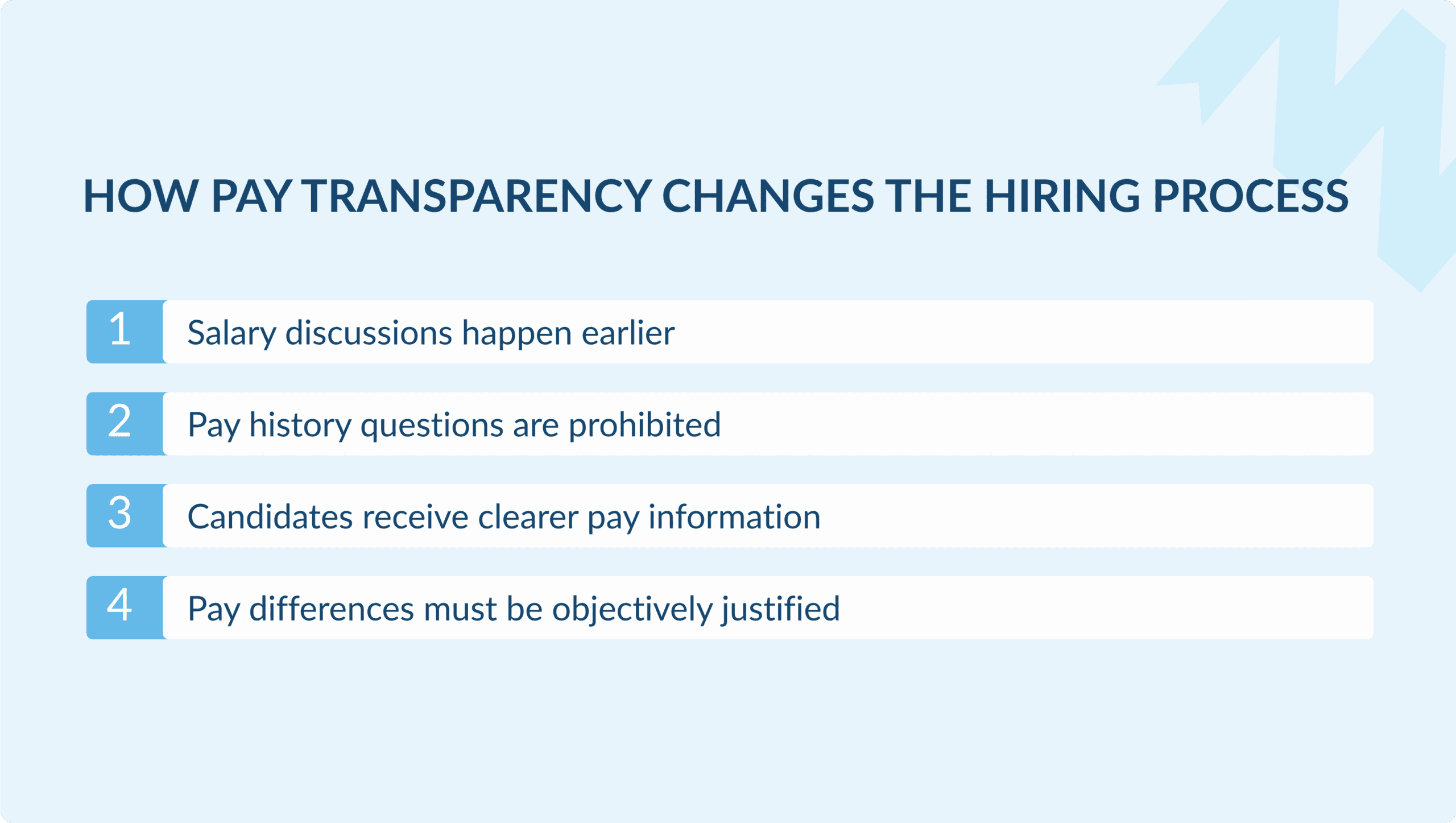
1. Salary conversations happen earlier
Applicants have the right to receive the initial pay or pay range before the recruitment process is concluded, in a way that supports informed and transparent negotiations. The Regulations do not expressly require every salary range to appear in the job advert, but employers must decide when and how the information will be provided consistently and early enough to meet the legal requirement.
Publishing the range in the advert may still be the best approach, even where it is not expressly required. It can level the playing field, reduce unsuitable applications and build trust.
2. No more asking about current pay
Employers and anyone recruiting on their behalf must not ask candidates about their pay history in either current or previous employment relationships. Hiring decisions should instead be based on the value of the position and on objective criteria relevant to the role.
This is an opportunity to reset how we define “worth.” Rather than anchoring offers to a candidate’s previous employer, we begin by defining what the role is truly worth in our organisation, placing equity and objectivity at the centre of our offer strategy.
3. Candidates and employees are more informed
Expect sharper questions about internal pay equity, career progression and how job roles are evaluated. If challenged, employers must be able to justify how job evaluation and categorisation were done.
Transparency invites scrutiny, but it also offers an opportunity. Organisations that can explain their internal structures with confidence and fairness will stand out. Those that cannot may see top talent walk away, even if the salary is attractive.
4. Differences must be justified
The regulations do not prohibit every difference in pay between people performing the same work or work of equal value. Differences and pay progression may be based on objective, gender-neutral and bias-free criteria, including performance and competence.
Beyond hiring: What does this mean for pay transparency during employment?
The Maltese regulations also introduce significant obligations concerning current workers. Pay transparency does not stop at hiring; it must be supported by the organisation’s pay structures, policies, records and day-to-day operations.
Here are the key requirements employers must keep in mind:
- Right to information: Workers may request written information about their individual pay level and the average pay levels, broken down by sex, for the category of workers performing the same work or work of equal value.
- Access to pay criteria: All employers must adopt and maintain written, objective and gender-neutral criteria for determining pay and pay levels and make those criteria accessible to workers at all times. The rules for different sizes of organisations vary, so it’s best to consult the law.
- Protected pay disclosures: Workers must not be prevented from disclosing their own pay to the relevant authorities, employee representatives or a chosen trade union for the purpose of enforcing their equal-pay rights.
- Annual notification: Employers must inform all workers annually about their right to request pay information and the steps required to exercise that right.
- Accessibility and records: Information supplied to applicants or workers under the recruitment, pay-policy and information provisions must be accessible to persons with disabilities, having regard to their particular needs. Employers must retain information and data connected with workers’ pay-information rights under regulation 6 for at least five years.
These changes mean HR and leadership teams will need to review systems, processes and internal capabilities:
- Is your payroll and HR system equipped to handle individual and comparative data requests?
- Do your line managers and employee representatives understand the new rights and how to respond to them?
- Have you done a job evaluation or reviewed your classification systems to ensure they hold up under scrutiny?
- Can you respond to an information request accurately and maintain an audit trail of the response?
- Are workers being reminded annually of their information rights?
Whether you are a small team or a large organisation, the central equal-pay, recruitment and worker-information duties cannot be ignored. The reporting threshold starts at 100 workers, but many of the obligations concerning applicants, pay structures, written criteria and individual information rights apply below that threshold.
When does gender pay-gap reporting begin?
Formal Pay Gap Reports are required from employers with at least 100 workers. The report must cover:
- The overall gender pay gap
- The gender pay gap in complementary or variable pay
- The median gender pay gap
- The median gap in complementary or variable pay
- The proportion of women and men receiving complementary or variable components
- The proportion of women and men in each quartile pay band
- The pay gap within each category of workers, broken down between ordinary basic pay and complementary or variable components.
The reporting timetable is:
- Employers with at least 250 workers must provide their first report by 7 June 2027, covering 1 January to 31 December 2026, and report annually thereafter.
- Employers with 150 to 249 workers must provide their first report by 7 June 2027, covering 2026, and report every three years thereafter. Employers with 100 to 149 workers must provide their first report by 7 June 2031, covering 2030, and report every three years thereafter.
- Employers with fewer than 100 workers may report voluntarily.
When is a joint pay assessment required?
A reporting employer must conduct a joint pay assessment with employee representatives where all three of the following conditions are met:
- The report shows a difference of at least 5% in the average pay of women and men in any category of workers.
- The employer has not satisfactorily justified that difference using objective and gender-neutral criteria.
- The employer has not remedied the unjustified difference within six months of submitting the report.
The joint pay assessment must be made available to workers and employee representatives and communicated to the Monitoring Body within 10 working days of completion. Any unjustified differences must then be remedied within the period agreed with the employee representative.
What does this mean for your employer brand?
Pay transparency does not just affect internal processes. It also shapes how your organisation is perceived in the employment market.
Your job adverts are now, more than ever, a public-facing statement about how much you value your people and transparency. Providing applicants with the initial pay or pay range, together with relevant collective agreement provisions where applicable, before the recruitment process concludes is the legal requirement. Publishing the range directly in the vacancy notice can go further by creating a clearer candidate experience and making the opportunity more compelling to the right talent.
Where a salary range is included, candidates can compare your offer with those of other employers before applying. Your competitive edge will therefore depend not only on how much you offer, but also on how clearly you explain the range and how consistently you position candidates within it.
Handled well, transparency builds trust, reinforces your commitment to fairness and attracts values-driven talent. Organisations that embrace the shift, rather than simply comply with it, will strengthen their reputation and long-term talent pipeline.
How can you stay ahead?
So, how can employers and recruitment professionals strengthen compliance now that the Maltese regulations are in force? Here are some practical steps:
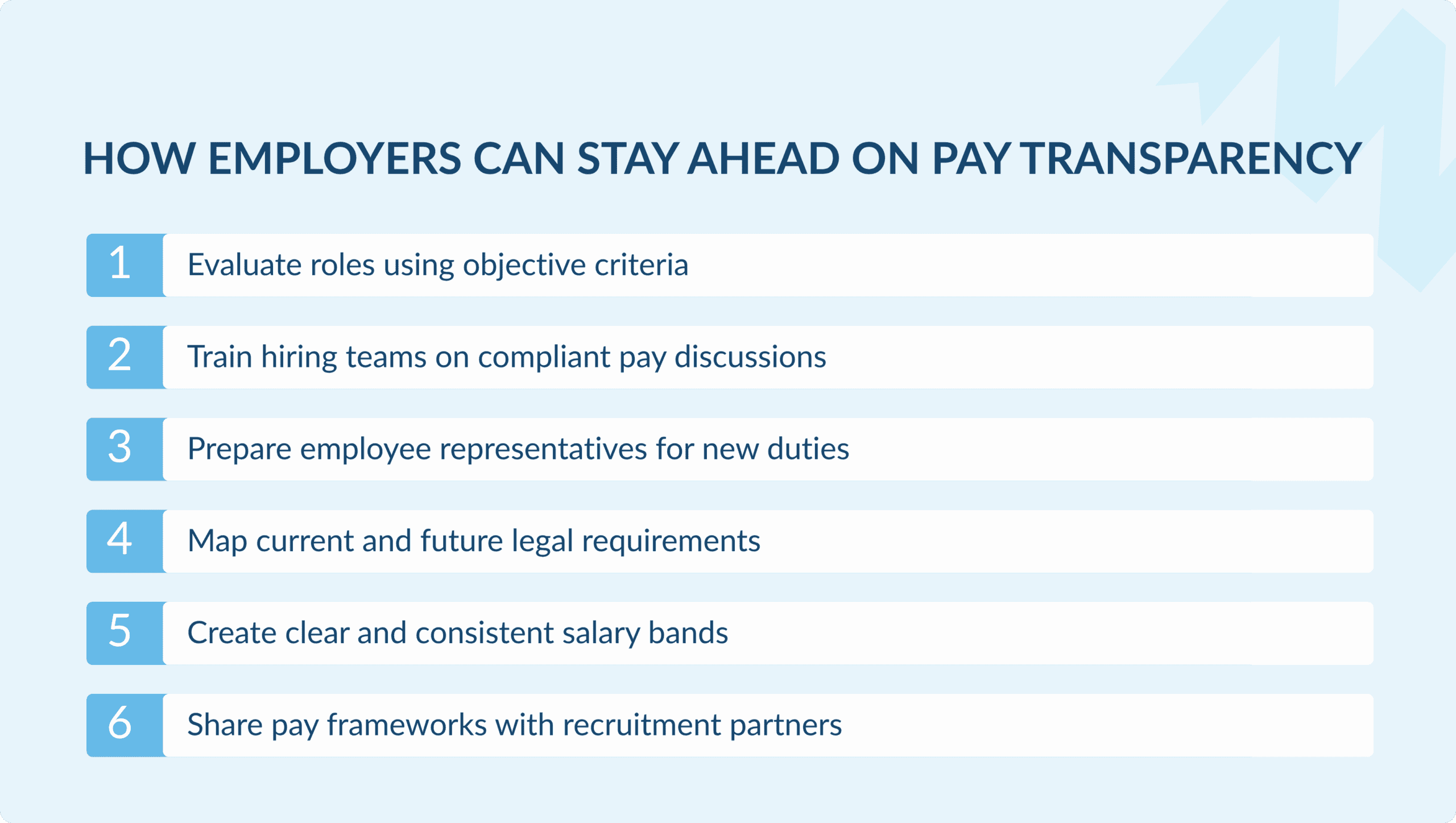
Analyse your job levels
Start with a thorough job evaluation process to determine the relative value of roles across your organisation. The focus here is not on individuals, but on the roles themselves. By comparing jobs rather than incumbents, you can create a pay structure that is fair, consistent and defensible. This helps ensure that employees are paid in line with the value of their role and that entry and performance criteria are clearly defined.
Document how skills, effort, responsibility, working conditions and relevant soft skills are evaluated. Review whether criteria that appear neutral could indirectly disadvantage one sex and involve employee representatives where required.
Train your hiring teams
Equip hiring managers and recruiters to navigate pay discussions confidently and compliantly. Make it clear that the employer and anyone recruiting on its behalf cannot ask applicants about current or previous pay. Establish when the initial pay or range will be disclosed and prepare hiring teams to explain the objective criteria used to position candidates within the range.
Upskill employee representatives
Employee representatives should understand the Maltese regulations and their role in job evaluation, information requests, reporting and joint pay assessments.
Know your legal responsibilities
Map the duties that apply to your organisation now and those that begin later. Confirm your workforce threshold, document pay-setting criteria, establish an eight-day information-request process and determine whether your payroll and HR systems can produce accurate category-level data. Employers approaching 100 workers should begin testing reporting capability well before their first statutory reporting period.
Standardise your job offers
Create clear salary bands for each role and guidance on how to position candidates at the lower or higher ends of those bands. You may wish to allow for some flexibility to tailor offers based on experience or qualifications, but always within a non-discriminatory, transparent and objectively justifiable framework.
Stay transparent with your recruiter
Your recruitment partner plays a crucial role in the hiring process. By sharing your salary frameworks openly, you help them position your roles competitively.
When you work with Konnekt, you also gain informed advice on market trends, helping you set realistic expectations and communicate clearly with candidates.
Recruitment can still be your advantage
Pay transparency may feel like a burden, but it is also a strategic opportunity. Done right, it:
- Reinforces fairness
- Enhances employer branding
- Improves long-term recruitment and retention
Malta’s new regulations require meaningful changes, but they also create space for smarter, more consistent and more strategic recruitment and retention.
Need recruitment support? Contact us today.
Frequently Asked Questions
Yes. The Regulations apply to employers in both the public and private sectors. While only employers with at least 100 workers must submit Pay Gap Reports, many of the recruitment, equal-pay and worker-information requirements apply to smaller employers too.
Not necessarily. Employers must provide applicants with the initial pay or pay range before the recruitment process is concluded. Any relevant collective agreement provisions must also be provided. Publishing the range in the advert is optional, but it is highly suggested as it makes the recruitment process clearer and more effective.
No. Employers must not ask applicants about pay received in their current or previous employment.
Workers may request information about their own pay and the average pay levels, broken down by sex, for workers doing the same work or work of equal value. They are not entitled to see any identifiable colleague’s individual salary.
Employers must provide the information in writing within eight days. If the request is not answered, the worker may follow the escalation process set out in regulation 6.
Yes, where the difference is based on objective, gender-neutral and bias-free criteria. These may include performance, competence, experience or qualifications where they are genuinely relevant and applied consistently.
Employers with at least 250 workers and those with 150 to 249 workers must submit their first report by 7 June 2027. Employers with 100 to 149 workers must submit their first report by 7 June 2031.
It is a detailed review carried out with employee representatives where a Pay Gap Report shows a gap of at least 5% within a category of workers, the gap cannot be objectively justified and it has not been corrected within six months.
Contraventions may result in fines of between €2,500 and €5,000. Higher fines of between €5,000 and €7,000 may apply in the circumstances set out in the Regulations. Workers may also claim lost pay and compensation.

About the author: Jonathan Camilleri, Head of Business Operations at KonnektTalexio. Since 2019, his journey at the company spans recruitment, training, and leading HR. He collaborates closely with legal advisors to align workforce strategy with employment compliance and Malta’s pay-transparency standards.