Recruitment best practice in Malta: A guide for hiring managers


Last updated
October 14, 2026
Share on


Hiring well in Malta requires a different approach from most markets. The talent pool is small, and top candidates often receive multiple job offers. News of a company’s hiring process spreads quickly on the island.
This guide covers the recruitment process for Malta-based employers, from writing a job description to closing a job offer. It’s based on Konnekt‘s experience of placing over 550 candidates per year across finance, tech, iGaming, legal, and generalist roles.
Why Malta’s job market demands a different approach
Recruitment strategies that work elsewhere often fail in Malta.
The workforce is small and connected. Candidates talk to each other, and a poor hiring experience can become well-known through word of mouth. This can happen quickly, given the island’s small size.
Top candidates, especially those with experience in iGaming, fintech, finance, or IT, are in high demand. They receive multiple job offers and make decisions quickly. A hiring process that prioritises the employer’s convenience over the candidate’s timeline can lead to losing top talent.
This doesn’t mean the process should be rushed. It should be efficient and deliberate. The following sections will cover each stage of the recruitment process.
How to write a job description that attracts candidates
The job description is a crucial tool in the recruitment process. Most job descriptions are written for internal use and then posted online. Candidates see a list of required skills, a vague job description, and no benefits or salary information. Top candidates often look elsewhere.
A job description should be a marketing tool. It should answer the question: why would I choose this role?
The five things candidates look for before applying:
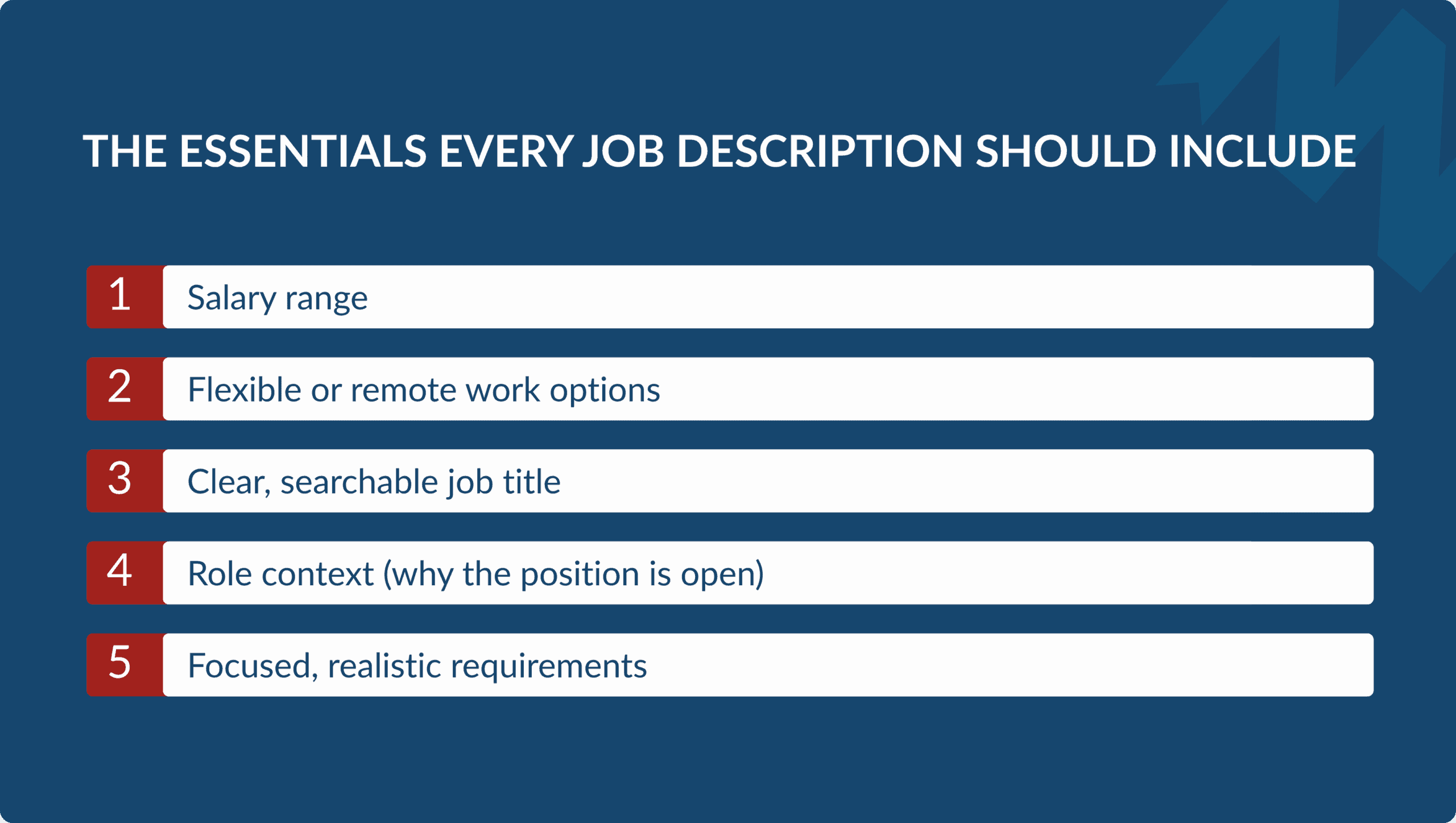
- Salary information. Omitting a salary band doesn’t protect your negotiating position, it filters out the candidates who know their market worth, which is usually the people you want most. If you can’t publish a fixed figure, a range is far better than nothing.
- Flexible working options. Candidates are looking for job opportunities with flexible or remote work options. If the role has flexibility, say so clearly.
- A clear job title. Standardise your titles. Internal titles that reflect internal culture (“Marketing Rockstar”, “People Champion”) confuse candidates searching on job boards and undermine professional credibility.
- Context. A short sentence explaining the context, whether it’s a growth hire, a replacement, a new function, helps candidates understand the opportunity.
- Focused requirements. Long lists of required skills, especially lists padded with “nice to haves” presented as requirements, discourage applications from strong candidates who match 70% of them. Separate the non-negotiables from the desirable, and keep the list short.
A well-written job description will attract more candidates and improve the hiring process.
How to structure your hiring process for the Malta market
Every unnecessary step in the hiring process can lead to losing a candidate. This is a common pattern seen at Konnekt. For example, a client once identified a top candidate and was ready to make an offer. However, a miscommunication led to an additional interview, which delayed the process. The candidate was still considering other options, and the delay almost cost the client the hire.
The three stages of the hiring process:
Stage 1 – Sourcing and brief. Be clear about the role, salary, and timeline. Avoid ambiguity, which can lead to delays.
Stage 2 – Screening and interviews. Decide on the number of interview rounds and make each one count. Two or three rounds are typical for most roles.
Stage 3 – Offer and close. Assign a clear owner and timeline for the offer stage. Set expectations with the candidate, such as “We’ll get back to you by [date].”
What good interviewing looks like in practice
The interview is where many processes fail, because the approach is often inconsistent.
The most common error we see in Malta is the unstructured interview: a conversation that flows from topic to topic based on what the interviewer finds interesting, rather than a consistent set of criteria applied to every candidate. The result is a decision made on impression and rapport rather than evidence, which makes it harder to compare candidates fairly and easier to make a hire you later regret.
Discovery over filtering. The best hiring managers see interviews as a chance to discover what candidates can do. They focus on understanding, not just eliminating candidates. For example, someone who struggles on a technical task may redirect the discussion to show their strategic thinking. These candidates often get overlooked when interviewers focus too much on filtering.
Behavioural and attitudinal signals matter as much as skills. We placed a candidate for a Project Coordinator role where the hiring manager, under time pressure to find a Maltese-speaking candidate, proceeded despite concerns we had flagged about the candidate’s professionalism during screening. The candidate left after two days. Skills and language fit cannot override behavioural red flags identified before hire.
Skill-based assessment is worth the effort. For roles with clear technical needs, using a practical task gives real evidence of capability. Keep it brief: a 30-minute task that mirrors actual work, not a long exercise that top candidates might skip due to time constraints.
Conversely, if a candidate excels in an assessment but you hire on instinct, the process fails. Structure matters only if you stick to it.
Making and closing the offer
In high-demand sectors in Malta, the speed of your offer is as crucial as the offer itself. Candidates often receive multiple offers soon after they become available. If a client takes two weeks to process an offer after the final interview, they risk losing candidates to quicker offers. A better salary arriving late might lose out to a decent one offered on the same day.
What delays an offer unnecessarily:
- Internal sign-off processes started too late
- Salary band flexibility needing escalation
- Relying on a single decision-maker who is unavailable
- Waiting for a second candidate to complete the process “just in case”
The solution is to prepare offers in parallel, not sequentially. While final interviews occur, draft the offer: confirm salary, prepare the contract template, and discuss the start date. If the answer is yes after the final interview, send the offer within 24-48 hours.
On salary negotiation. Candidates with three or more years of experience, know their market value. If your salary band is outdated, it may not be competitive. A candidate asking for more isn’t unreasonable; they might just understand the market better than your benchmarks.
Candidate experience is your employer brand
How you treat candidates affects your reputation. Candidates research companies before applying. They check your LinkedIn and often ask their network. A candidate with a poor experience two years ago may still be active and sharing their story. A company that spends on advertising while running a disorganised process creates a reputation problem.
Specific Issues Candidates Notice: Slow communication after interviews, vague feedback, ghosting after the final round, and last-minute schedule changes without explanation.
Fixing these issues doesn’t require significant resources. It needs ownership of the process and a commitment to keeping candidates informed.
A practical minimum standard:
- Acknowledge every application within a working day
- Set a clear timeline at each stage and stick to it
- Give feedback, even when the answer is no
- Don’t leave a candidate waiting more than 48 hours after a final interview without an update
These are baseline expectations for any candidate you want to attract. For more on recruitment and employer branding, see our guide on employer branding in Malta.
When to work with a recruitment agency and what to expect
Not every hire needs an agency, and a good agency will tell you when. Here’s when it adds value and when it doesn’t.
| Scenario | Internal hiring viable? | Agency adds value? |
| High-volume, entry-level roles with standard requirements | Yes | Low, unless volume is very high |
| Niche specialist roles (finance, tech, compliance) | Possible, but slow | High – access to passive candidates |
| Confidential or sensitive senior appointments | Difficult | High – discretion is core to the service |
| Replacement of a departing employee under time pressure | Possible if pipeline exists | High – speed and existing shortlist |
| First hire in a new function you don’t know well | Risky | High – market intelligence alongside matching |
| Repeated failed direct search for the same role | No | High – different pool, different method |
In Malta, the case for an agency is access. An agency with an established candidate database can reach people who aren’t looking, often resulting in the best hires.
Konnekt has been placing candidates in Malta since 2007. We have the largest registered candidate database on the island. Our teams cover finance, legal, tech, iGaming, executive search, and general roles. Learn more about our recruitment services or contact us to book a meeting with one of our recruiters.
Frequently asked questions
From initial brief to placement, the average across Konnekt’s placements is around 97 days. This varies significantly by role type: generalist and administrative roles tend to close faster (four to six weeks), while specialist roles in finance, IT, or compliance can take longer, particularly if the candidate pool is narrow.
Yes, in most cases. Candidates cite salary and benefits as the main factors influencing their application. Leaving it out doesn’t preserve negotiating leverage, but filters out experienced candidates who won’t apply without it. A salary range works well where a fixed figure isn’t practical. The only exceptions are highly confidential senior roles where salary disclosure is sensitive.
Two rounds is standard for most roles. Three rounds is acceptable for senior or specialised positions. More than three rounds is unusual and risks candidate drop-off, especially in competitive sectors. If you find yourself adding rounds due to uncertainty, the issue usually lies in the brief or assessment criteria, not the number of conversations.
Common reasons include: delays without communication, offers arriving too late, and salaries below expected market rates. Most of these issues can be avoided with upfront clarity and a well-managed timeline.
Use a recruitment agency for specialist roles, stalled internal searches, time-sensitive hires, or when you need access to candidates not actively applying. Direct hiring is more time-consuming, but it might still be effective if you have a good candidate pool or if placing a candidate is not urgent.
One month is the most common notice period under Maltese employment law for roles up to a certain tenure, though this increases with length of service under the Employment and Industrial Relations Act (Chapter 452). Senior roles often have contractual notice periods of two to three months.

About the author: Emma joined Konnekt in 2021 and has been working in recruitment ever since. She began her career as a Recruitment Specialist within the Finance & Legal Recruitment Team before expanding her expertise across other sectors, including Tech. Over the years, she progressed in her role and now oversees all recruitment teams in her current position as Recruitment Operations Manager.