Recruitment services in Cyprus


Share on


A recruitment agency in Cyprus helps employers define a vacancy, identify suitable active and passive candidates, assess fit, coordinate interviews, manage offers and support the placement after hiring. This matters because hiring in Cyprus is structurally difficult: unemployment is low, the local workforce does not match every type of vacancy, specialist talent pools are small, and international hiring can be slowed by permit requirements. Employers therefore face two different shortages at once: insufficient local interest in many operational roles and insufficient supply for specialist positions in technology, finance and healthcare.
Why hiring in Cyprus is harder than it looks
Hiring in Cyprus is difficult because the problem is not simply a lack of applicants. It is a mismatch between the people available, the work employers need done and the time businesses can realistically wait.
What we see consistently from employers approaching us is a dual structural problem. Cyprus has a highly educated local workforce, but many candidates are overqualified for hands-on positions in hospitality, construction and retail, or do not see those roles as a sustainable career choice. At the same time, employers in technology, financial services and healthcare are competing for specialist talent that exists in very limited numbers locally.
Low unemployment makes that competition more intense. In the third quarter of 2025, the Cyprus Statistical Service reported an unemployment rate of 4.1%, down from 4.5% a year earlier. These figures do not mean that every available person has the right skills, experience, language ability or salary expectations for every vacancy. They mean employers are searching within an already tight market.
The most critical shortages we encounter are among software developers, systems analysts and nurses. These roles require qualifications and practical experience that cannot be developed quickly. Employers are often competing for the same small group of professionals, including candidates who are already employed and are not actively applying for jobs.
International recruitment helps widen the pool, but it does not provide an instant solution. For many third-country nationals, the temporary residence and work permit process can take up to four months after a complete application is submitted. Employers frequently underestimate this when setting a target start date. Document collection, approvals and incomplete submissions can add further delay, so a role advertised today may not result in an overseas hire starting next month.
The composition of the workforce also shows why local-only hiring is becoming less realistic. Based on Eurostat employment data by citizenship, approximately 48% of employment growth in Cyprus since 2015 has come from EU nationals and third-country nationals. The share of Cypriot nationals in employment declined from about 80.5% in 2015 to 72.0% by 2025. In practical terms, employers need hiring processes that can reach people across different nationalities, explain relocation clearly and account for permit timelines from the beginning.
What Konnekt does differently as a recruitment agency in Cyprus
A recruitment agency adds value when it understands the pressure on the employer and the genuine aspirations of the candidate. Filling a vacancy is not enough if the person leaves shortly afterwards or accepts for the wrong reasons.
At Konnekt, our starting point is human. We look beyond the job title and the CV. We need to understand what the employer is trying to solve, how the team operates and what success in the role will look like after six or twelve months. We also need to understand what the candidate wants from their next move, including responsibilities, development, working style, salary and long-term direction.
Transparency is the baseline. We communicate openly with both sides throughout the process. Candidates should know where they stand, what the role involves and what the next step is. Employers should receive an honest view of candidate availability, salary expectations and any concerns that may affect the placement. Recruitment becomes frustrating when communication stops, feedback is delayed or expectations change without explanation.
We deliberately refuse to treat recruitment as a transactional numbers game. Sending a large batch of CVs can create the impression of speed, but it often transfers the screening burden back to the employer. Our aim is to present a small, relevant shortlist of people we have assessed properly.
When I visit a client’s office before we begin searching, I am not simply gathering a job specification. I look at how the team interacts, what the culture feels like, who the person will report to day to day and how decisions are made. I ask why the vacancy exists and what has made previous hires successful or unsuccessful. That changes who we approach and how we present the opportunity.
This is also why we do not rush to send candidates without a proper briefing, even when a client asks for immediate CVs. Speed matters, especially for a replacement hire, but an unclear search usually creates more delay later. The wrong candidates are interviewed, feedback becomes inconsistent and the brief changes halfway through the process.
Konnekt focuses on quality over volume and does not compete by reducing recruitment to the lowest fee. The useful comparison is not the cost of receiving CVs. It is the value of appointing someone who fits the role, understands the organisation and is likely to stay. A careful process may require more work at the start, but it protects placement quality and reduces the risk of restarting the search.
How Konnekt’s recruitment process works
- Initial briefing
We begin with a detailed conversation and, wherever possible, meet face to face at the client’s office. The purpose is to understand the business, the team, the culture, the vacancy and the reason the role is open. - Role mapping and requirements clarification
We separate genuine must-haves from preferences. This includes technical skills, qualifications, experience, language requirements, working arrangements, salary and the outcomes expected from the person during their first months. - Structured internal candidate assessment
Candidates are assessed through a consistent internal process. We consider relevant experience and skills, but also motivation, communication style, values, career direction and alignment with the working environment. - Shortlisting
Employers normally receive a curated shortlist of three to five highly relevant profiles rather than a large volume of unfiltered CVs. Each presentation should make clear why the person fits and where further discussion may be needed. - CV presentation and client feedback
We present suitable candidates and discuss the employer’s response. Timely, specific feedback helps us refine the search, keep candidates engaged and prevent strong applicants from accepting another opportunity while waiting. - Interview coordination and candidate preparation
We coordinate schedules, confirm the process and prepare candidates for the discussion. Preparation is not about rehearsing answers. It ensures the candidate understands the company, the responsibilities and what the employer wants to assess. - Offer management, placement and post-placement follow-up
We support both parties through salary discussions, notice periods, start dates and final expectations. After placement, we follow up with the employer and candidate to identify any concerns early and support a successful transition.
The process works best when the employer commits to timely feedback and appoints one clear internal decision-maker. Multiple reviewers can be involved, but responsibility for progressing the hire should not be unclear. A good candidate market moves quickly, and delays of even several working days can change the outcome.
What to give your recruitment consultant at the start
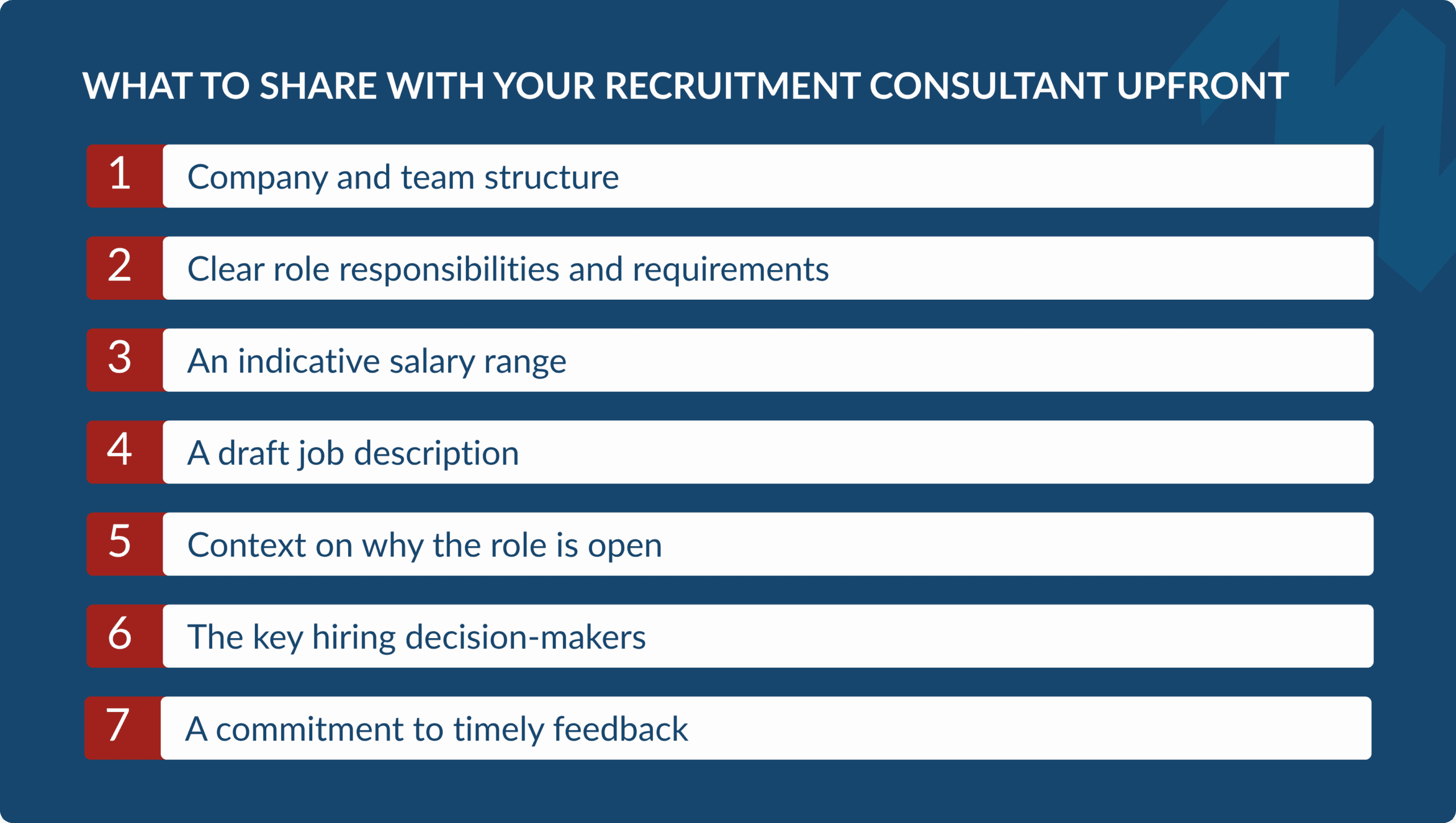
Provide the following information before the search begins:
- The organisation’s total headcount, the structure of the relevant department and who the role reports to
- The core responsibilities and key requirements, clearly separating must-have criteria from desirable experience
- A salary range, even if it is broad, because compensation is often the first factor candidates use to decide whether a role is worth discussing
- A draft job description, even if it still needs improvement
- Whether the position is newly created or a replacement, and why the previous employee left where relevant
- The people responsible for reviewing CVs, conducting interviews and making the final decision
- A commitment to provide timely feedback to the recruitment consultant after each stage
This information speeds up the search because it allows the consultant to target the right people, answer candidate questions and identify potential misalignment before the offer stage. It also prevents the brief from changing after strong candidates have already invested time in the process.
When does a recruitment agency add value in Cyprus?
A recruitment agency adds the most value when the candidate pool is limited, difficult to identify or unlikely to respond to a standard advert.
| Scenario | Internal hiring viable? | Agency adds value? |
| Niche tech, finance or compliance role | Possible but slow, with a limited local pool | High, through access to passive candidates |
| Role requiring a native Greek-speaking specialist | Difficult | High, through targeted market mapping |
| Confidential or senior appointment | Difficult | High, because discretion is central to the service |
| First hire in a function you do not know well | Risky | High, with market intelligence alongside matching |
| Replacement hire under time pressure | Possible if an internal pipeline exists | High, through speed and an existing shortlist |
| High-volume entry-level roles with standard requirements | Yes | Lower, unless the required volume is very high |
A good agency should also tell an employer when recruitment support is not the right tool. There are roles where an internal pipeline, referral programme or direct advert is likely to work well. Konnekt will say so rather than recommending an agency search where it adds little value.
A real example – filling a niche IT role in Cyprus
A client needed to appoint someone to a niche IT position in Cyprus. The technical requirements were already demanding, but the candidate also had to be a native Greek speaker. That reduced an already limited local technology pool to a very small group.
Direct advertising was unlikely to work. Most professionals who matched both the technical and language criteria were already employed and were not actively checking job boards. A standard vacancy advert would mainly reach candidates who were available, not necessarily the candidates who could meet the complete brief.
Konnekt used LinkedIn as the primary headhunting tool. We mapped the local market, identified professionals with the relevant background and approached suitable passive candidates directly. Each conversation tested technical alignment, motivation and whether the opportunity represented a credible next step.
The vacancy was successfully filled to the client’s exact specifications. The broader lesson is simple: in a tight specialist market, the difference between filling a role and leaving it open for months often comes down to whether you are reaching people who are not looking.
Frequently asked questions
The process normally starts with a detailed employer briefing covering the role, salary, reporting line and selection process. The agency then sources and assesses candidates, presents a shortlist, coordinates interviews and supports offer discussions. At Konnekt, the typical shortlist contains three to five relevant profiles, followed by feedback, interview management, placement and post-placement follow-up.
A generalist role may produce a suitable shortlist within two to four weeks, while specialist positions in technology, finance or healthcare can take six to twelve weeks or longer. The employer’s interview speed and salary range affect the outcome. When hiring a non-EU candidate, the work permit process can add up to four months after a complete application, so this must be included in the hiring plan.
Technology and healthcare face some of the clearest shortages. Software developers, systems analysts and nurses are particularly difficult to recruit because Cyprus has a small local pool and employers often require qualifications or experience that take years to develop.
Provide the organisation and department structure, reporting line, core responsibilities, must-have and desirable requirements, salary range and a draft job description. Confirm whether the role is new or a replacement. You should also identify who reviews CVs, who interviews and who makes the final decision. Agreeing to provide feedback within two or three working days helps keep suitable candidates engaged.
A job board mainly reaches active candidates who are searching and willing to apply. A recruitment agency can also search an established database, map the market and approach passive professionals directly. This is particularly important for niche or senior roles. In the Greek-speaking IT case described above, direct headhunting reached qualified people who were not responding to adverts.
Yes. Konnekt operates in Cyprus under Employment Agency Licence No. 562. It works across Malta and Cyprus as part of the KonnektTalexio Group and manages recruitment from briefing and sourcing through to interviews, offers and follow-up. Konnekt was founded in Malta in 2007 and now supports Cyprus employers across specialist, generalist, operational and senior appointments.
Hiring in Cyprus becomes more manageable when the search is based on a realistic brief, direct access to the market and clear communication with candidates. To discuss a vacancy or find out how Konnekt works with employers in Cyprus, contact our team directly.

About the author: With more than 15 years of experience in Human Resources, Christiana has built a successful career, starting at KPMG and later taking on strategic HR roles in organisations such as EY.
Specialising in recruitment, talent acquisition, and cross-border hiring, she focuses on creating solutions that connect talented people with the needs of organisations, helping businesses build strong teams that drive growth.